
BUSINESS
Powder Business
Improved Quality and Stable Operations Through Powder Technology and Refractories for Continuous Casting
Continuous casting is a key process in steel production and essential for manufacturing high-quality steel.
Powders are indispensable materials used in the continuous casting process.
Together with refractories for continuous casting, KROSAKI HARIMA contributes to improved steel quality and stable operations through its advanced powder technology.
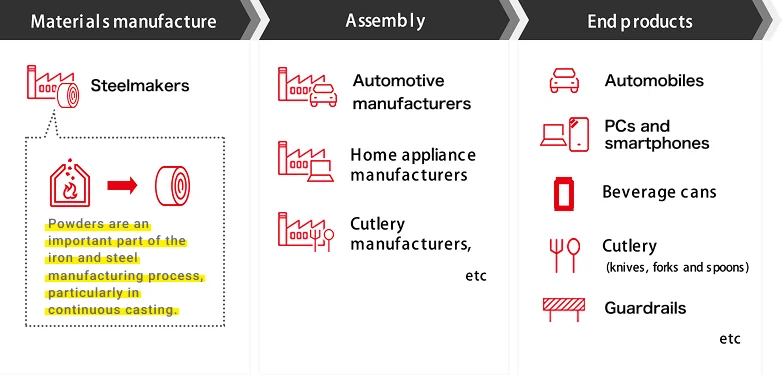
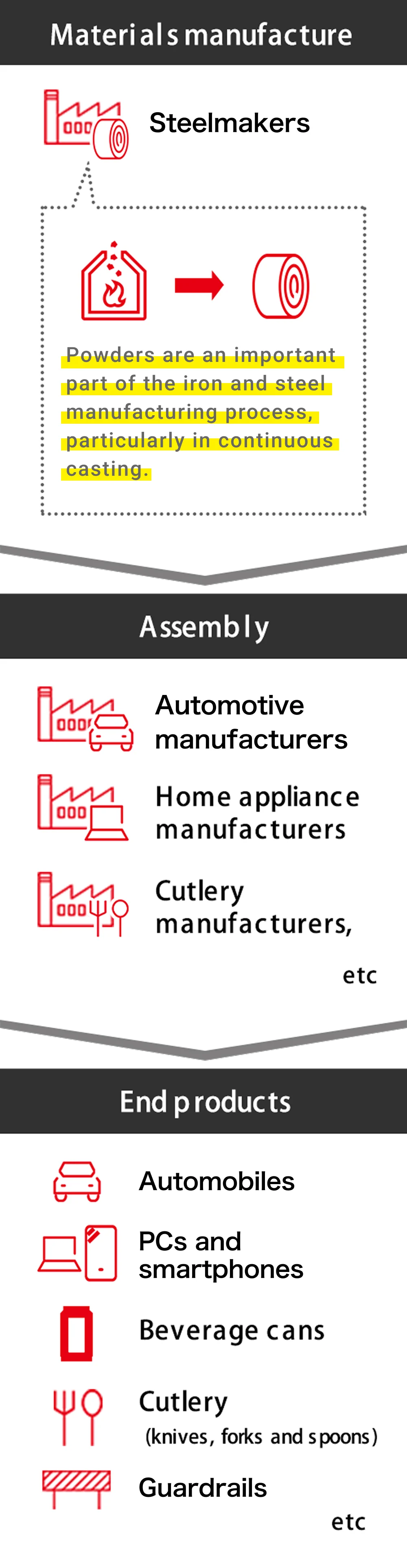
Iron and steel
Major Customers
Iron and steel
-
-
JFE Steel Corporation
-
Kobe Steel, Ltd.
The Importance of Powder in the Continuous Casting Process
—Designing Powder—
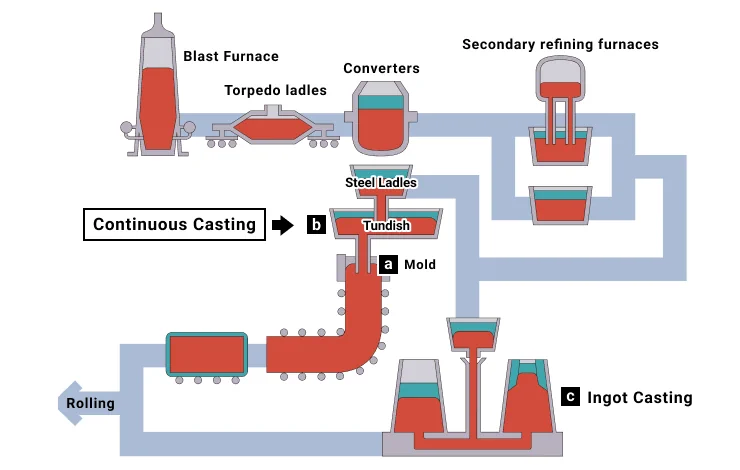
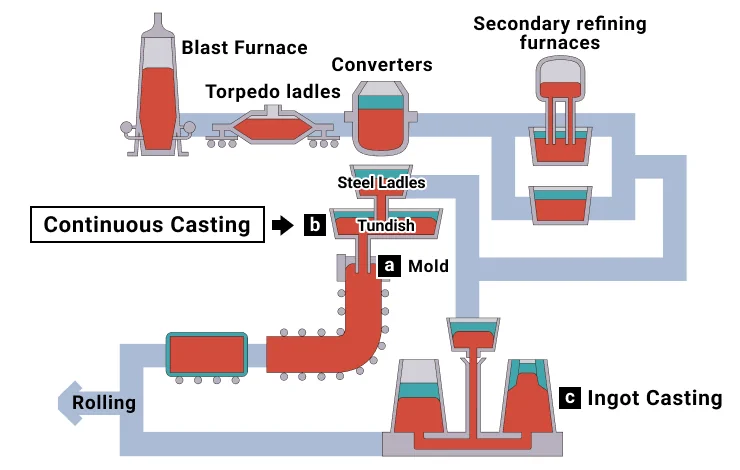
Steelmaking Process and Powder
Powders are important materials used in the continuous casting process at steelmakers.
To contribute to stable casting operations and the production of high-quality cast products, we develop the most suitable powder for each steel grade, casting condition, and continuous casting machine.
*Some powders are also used in ingot casting.
 Steelmaking Process
Roles of Mold Powder in Continuous Casting
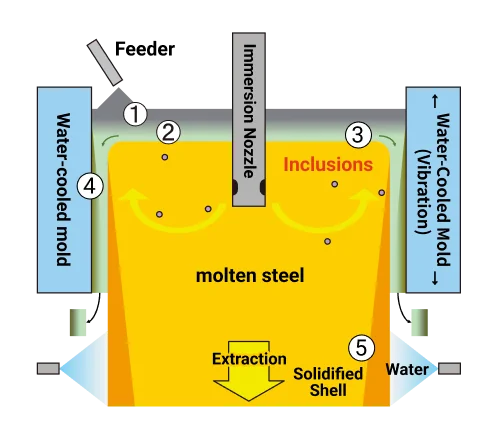
aMold Powder
Mold powder melts under the heat of molten steel and forms a molten flux.
It then flows into the gap between the mold and the solidified shell, where it fulfills its various functions.
Roles of Mold Powder
1.To provide thermal insulation for molten steel in the mold
2.To prevent oxidation of molten steel
3.To absorb and remove inclusions
4.To ensure lubrication between the mold and the solidified shell
5.To control the primary cooling of cast slabs and assist in the sound formation of the solidified shell

bTundish Powder(Tundish Powder for Molten Steel)
Tundish powder is designed to maintain the temperature of molten steel in the tundish and prevent reoxidation of the molten steel.
In addition, it absorbs and removes inclusions in the tundish, helping to improve the cleanliness of molten steel.
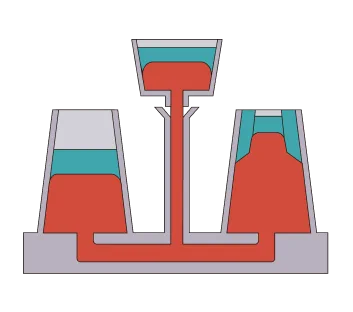
cOther Powders (Bottom-Pouring Ingot Casting Powder)
This powder is used in ingot casting molds for bottom-pouring applications.
It is applied during bottom-pouring ingot casting to prevent oxidation of the molten steel surface and to provide thermal insulation.
Powder Particle Types
Powders are available in two types: the blended powder type, which consists of finely mixed raw materials, and the hollow granule type, which is produced by granulating molten-process raw materials into hollow particles.
The hollow granule type, in particular, offers a variety of features that deliver superior performance.
Key Features of the Hollow Granule Type
- Generates less dust and provides excellent thermal insulation due to its hollow structure, helping to maintain molten steel temperature.
- Its spherical shape provides excellent flowability, allowing it to spread smoothly over the molten steel surface after being added to the mold.
- Compared with the blended powder type, it tends to exhibit a more stable melting behavior in the mold.
- Raw materials are dispersed uniformly in slurry form before granulation, resulting in consistent quality with minimal variation.
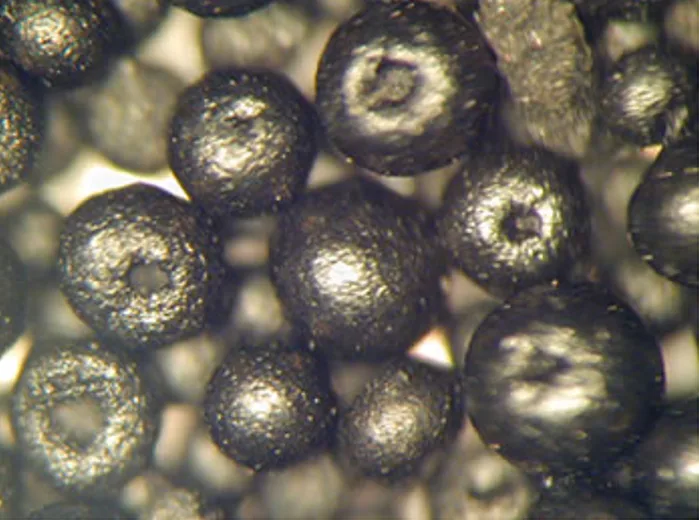
(Average particle size: 400–500 μ)

(High-speed Mixing to Granule Discharge)
Integrated Solutions with Flow Control Refractories
Leveraging our strengths as a supplier of both refractories and powders for continuous casting, we support further improvements in product performance and the realization of optimal casting environments.
Drawing on the technology and expertise accumulated through many years of experience in the continuous casting field, we help our customers solve operational challenges.
- Contributes to steel quality and stable casting operations in continuous casting.
- Physical properties of powder are optimized according to steel grade, casting conditions, and continuous casting machine requirements.
- Hollow granule type products are also available.
Delivering Improved Steel Quality and Stable Continuous Casting Operations Through Powder Technology and Refractories