


K-Damper™
Interview | Revolutionizing Tertiary Air Dampers for the Cement Industry
K-Damper™
Team Member
- Kensuke Morita, Sales Department Technician, Refractaria S.A.U. (Manager in Krosaki Harima Corporation)
- Carlos Tirados Sanjurjo, Manager, Engineering Department, Refractaria S.A.U.
As part of the Krosaki Group, Refractaria in Spain is committed to developing high-performance refractory solutions that enhance the efficiency, durability, and sustainability of industrial processes. In this edition of the K-GenesisX™ Interview series, we speak with Carlos, from the Engineering Department at Refractaria, about their latest innovation – the K-Damper™. This new-generation tertiary air damper redefines durability and process stability in cement production.
The interviewer is Mr. Morita, a manager at Refractaria who was dispatched from Krosaki Harima Corporation.
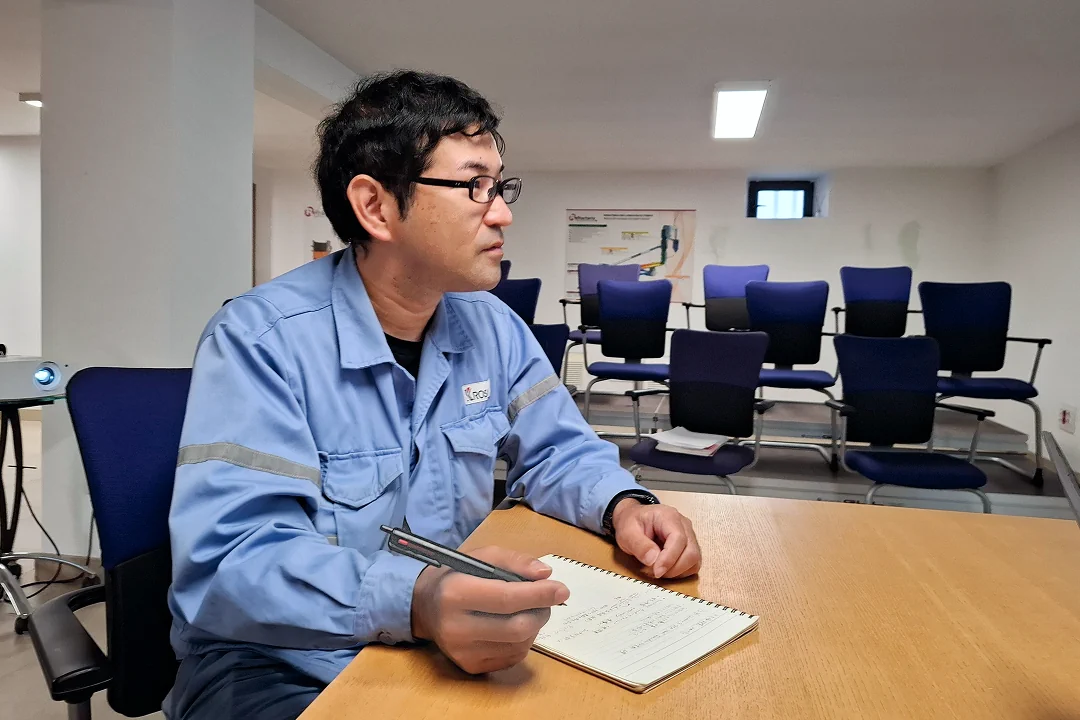
Morita: Thank you for joining us, Carlos. To begin, could you explain what the K-Damper™ is and what makes it different from traditional TAD dampers?
Carlos:
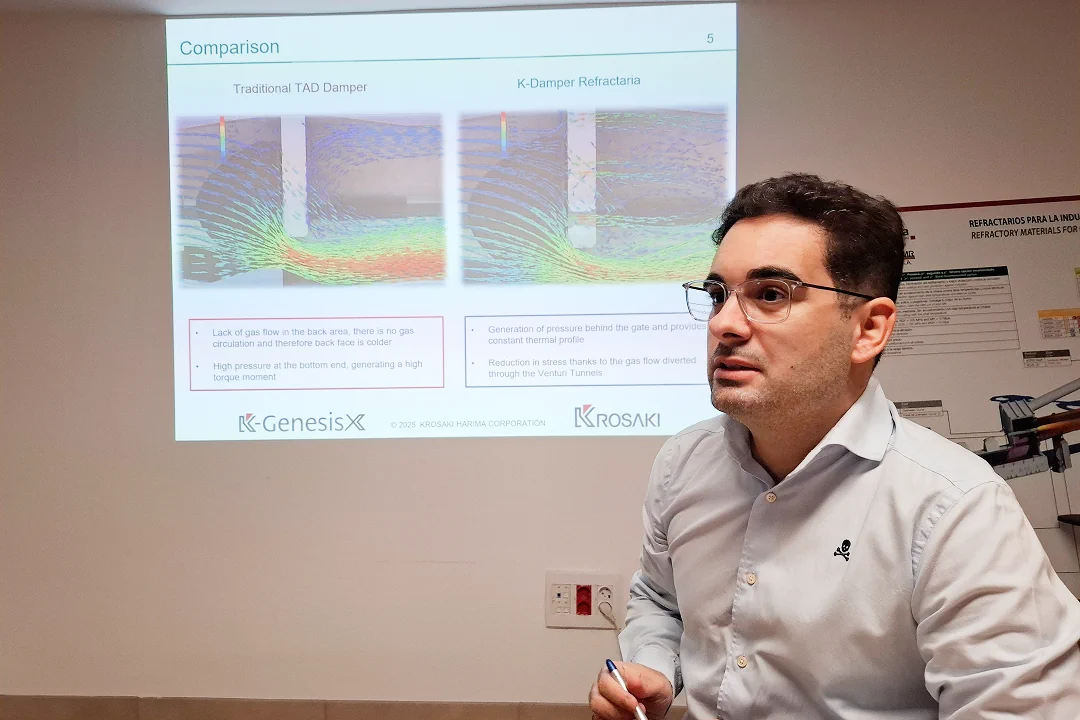
The K-Damper™ is a tertiary air damper designed to withstand the extreme temperature, velocity, and abrasion inside the tertiary air duct of cement kilns. Unlike conventional dampers, which use a steel structure covered with refractory castable, the K-Damper™ is made entirely from high-quality refractory materials with uniform thermal and mechanical properties. This provides superior structural stability and durability.
Morita: Traditional dampers tend to fail relatively quickly in harsh environments. What are the main challenges your team sought to overcome with this design?
Carlos:
Traditional TAD dampers often fail within weeks or months because their design includes materials with very different thermal expansion coefficients. This creates cracks, exposing the steel to abrasion and thermal stress. Our goal was to eliminate that weakness by designing a damper that behaves as one integrated refractory structure – uniform in behavior, even under extreme thermal profiles.
Morita: How does the K-Dampertm™’s Venturi tunnel design contribute to its performance?
Carlos:
The Venturi tunnels are a key part in this assembly. They generate a gas flow from the hot side to the cold side of the damper, reducing backpressure and mechanical stress. This helps reduce bending or flexion, ensuring that the component remains stable over long operational cycles. If needed, the tunnels can be blocked to allow the damper to operate in traditional mode – offering flexibility to our customers.
Morita: What benefits does this bring to cement plant operators?
Carlos:
K-Damper™ ensures a continuous tertiary air flow operation, which helps maintain stable process conditions in our customers’ kilns. Because it doesn’t suffer from early failures or blockages, plants experience fewer stoppages, reduced maintenance time, and improved productivity.
Morita: You also mention environmental advantages. Could you elaborate on that?
Carlos:
Of course. By maintaining stable air flow and optimizing the combustion process, K-Damper™ helps improve energy efficiency by controlling the recirculation of waste hot gas, thus reducing fuel consumption. This directly translates to lower CO₂ emissions – supporting both cost savings and environmental responsibility.
Morita: From an engineering standpoint, what was the most rewarding part of developing the K-Damper™?
Carlos:
Seeing the first units perform flawlessly in real operating conditions was extremely rewarding. It validated our design philosophy and confirmed that refractory-only solutions can perform better than traditional mixed-material designs in extreme environments.
Morita: Finally, what message would you like to share with Krosaki’s customers about this innovation?
Carlos:
The K-Damper™ represents our dedication to continuous improvement and innovation. It’s not just a product – it’s a step forward in how we think about refractory engineering for cement production. We want our customers to know that we’re committed to solutions that last longer, perform better, and contribute to a more sustainable industry.
With innovations like the K-Damper™, Refractaria and the Krosaki Group continue to set new standards in refractory technology – combining performance, reliability, and sustainability to meet the evolving needs of the global cement industry.