
Dry-Free™|Monolithic refractory used for lining and repairing various furnaces and incinerators

K-GenesisX™

Dry-Free™

Background

Dry-Free™ Shape

Features of Dry-Free™

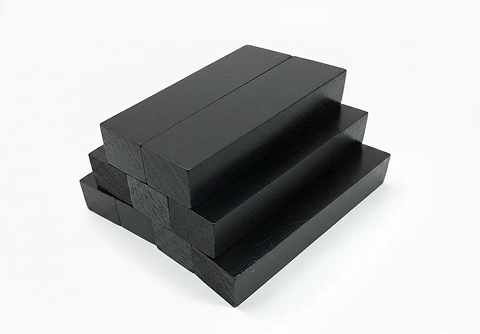
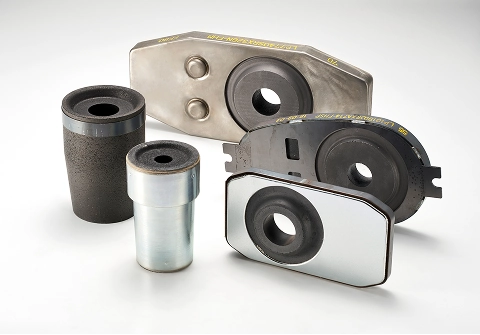
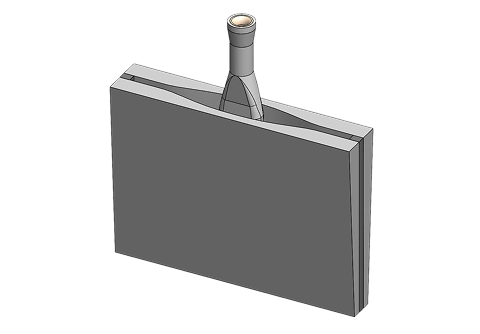
Dry-Free™ is a monolithic refractory used for lining and repairing various furnaces and incinerators in steel and non-ferrous metal industries.
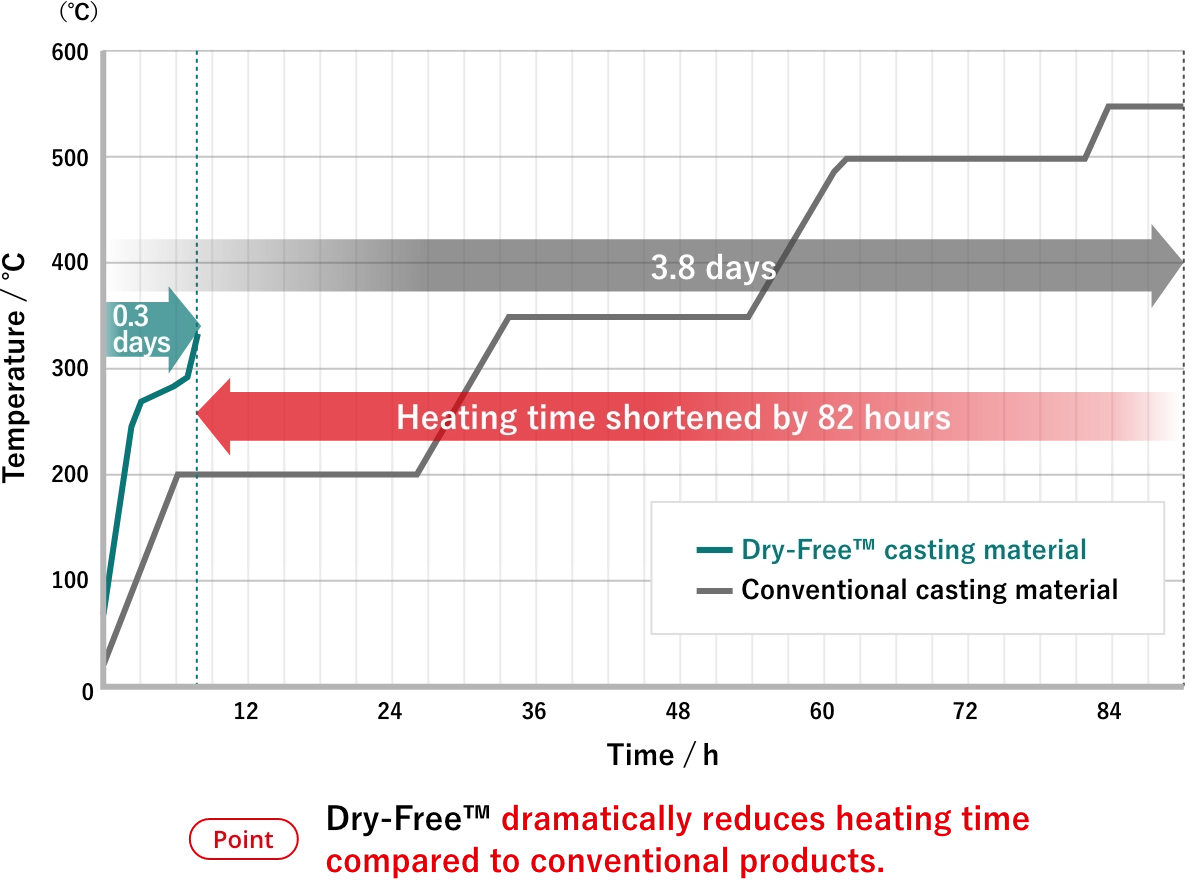
Conventional monolithic refractories require long drying time through furnace heating before use, causing operations to stop and creating idle time during heating.
Dry-Free™ is a groundbreaking monolithic refractory that eliminates the need for this drying process.

Dry-Free™ dramatically reduces heating time compared to conventional products
*The above graph is just an example. Heating time varies depending on the customer’s equipment, thickness of the installed monolithic refractories, and other factors.

Moreover, Dry-Free™ has been successfully selected for the top award of “Kitakyushu Eco Premium,” which is Kitakyushu City’s (Located in Fukuoka prefecture, Japan) designation for environmentally friendly products.

Presentation Materials and inquiries for Dry-Free™

Background

Advantages of Dry-Free™

1 Improved furnace operation rate by eliminating the drying process

Conventional monolithic typically require a drying process of up to one week before furnace use, depending on the customer. With Dry-Free™, such long drying times become a non-requirement, and the furnace can be dried with just preheating before use.
This reduces operational stoppages (idling time), thereby increasing the furnace operation rate. This leads to improved productivity, reduced opportunity losses, and shorter construction periods.

2 Preventing explosive spalling during drying to reduce furnace damage and accident risks

Conventional monolithic refractories sometimes experience explosive spalling & damage caused by steam pressure building up inside the installed material when dried too quickly at high temperatures, and this highly disrupts stable operations. Therefore, it is necessary to dry slowly at low temperatures over a long period of time.
Dry-Free™, on the other hand, with its highly improved permeability, prevents buildup of internal steam pressure. This eliminates the risk of explosive spalling, allowing for safe use and stable operations.

3 Reduction of repair and replacement costs through longer service life

Dry-Free™ improves heat resistance, corrosion resistance, and crack & spall resistance.
As a result, it achieves longer service life and contributes to the reduction of customers’ service life cycle costs (LCC).

4 Reducing CO₂ emissions in the drying process

Dry-Free™ reduces CO₂ emissions through its non-requirement of drying, conventionally generated by the combustion of fossil fuels and other fuels necessary for drying.
This leads to fuel cost savings (such as on heavy oil and gas).

Presentation Materials and inquiries for Dry-Free™

CO₂ Emissions Reduction Data for Dry-Free™

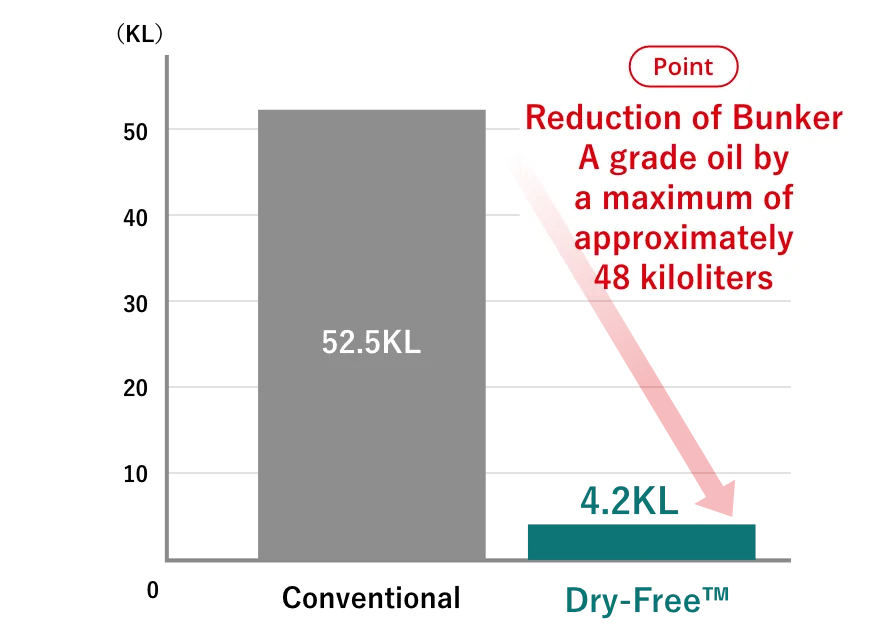
Our customers in Japan who incinerate industrial waste have been able to reduce the use of Bunker A grade oil for drying operations by upto 48.3 kiloliters by adopting Dry-Free™.
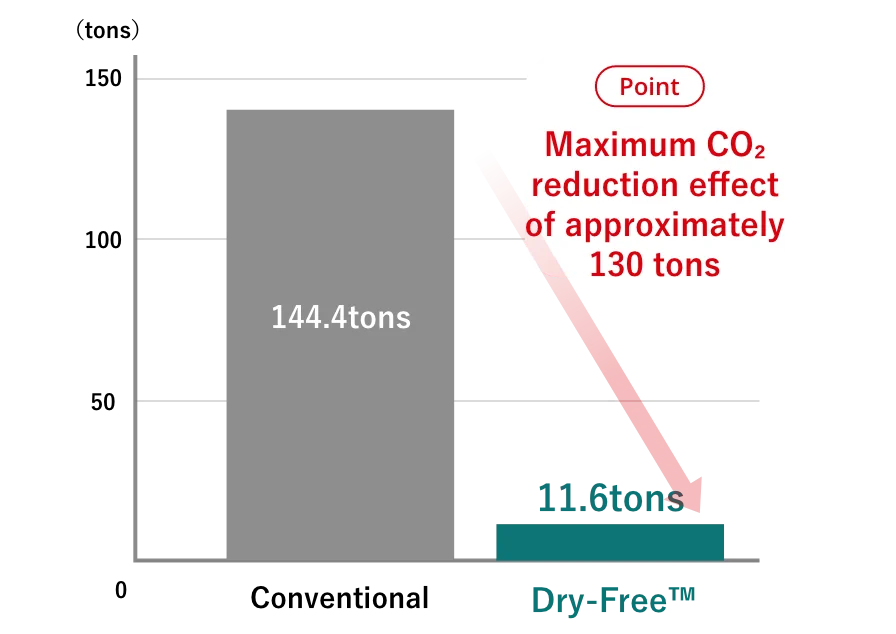
This is equivalent to a maximum CO₂ reduction effect of 133 tons per construction project.

Amount of Bunker A grade oil used

Reduction of Bunker A grade oil by a maximum of approximately 48 kiloliters

CO₂ emissions

Maximum CO₂ reduction effect of approximately 130 tons

*Carbon dioxide emission factor (Bunker A grade oil): 2.75 t-CO₂/kl (Source: Ministry of the Environment “List of Calculation Methods and Emission Factors in the Calculation, Reporting, and Publication System”)

*CO₂ emission reduction effect varies depending on the drying process time and the type/amount of fuel used

K-GenesisX™

Strategic Products

  • IconSteel

TOUGHMAX™ Background

Furnace
Furnace

Features

Compared to conventional magnesia-carbon bricks, these refractory bricks are less prone to internal crack growth and less susceptible to breakage.

Durability is high, so...

  • Equipment service life is longer, reducing customers’ refractory consumption

  • Carbon dioxide emissions from blast furnaces are reduced by increasing scrap (reducing hot-metal)

More

  • IconSteel
  • IconNon-
    ferrous
  • IconIncine
    ration

Dry-Free™ Background

Monolithic
Monolithic

Features

This is a groundbreaking monolithic refractory that eliminates the need for a drying process, significantly reducing heating time before use and making furnace startup easier.

No drying process is needed, so...

  • Construction and repair periods can be shortened, increasing furnace operation rates and improving productivity

  • Fuel consumption is eliminated, reducing CO₂ emissions

More

  • IconSteel

EVERCLEAN™ Background

Flow control
Flow control

Features

Used in immersion nozzles and similar components, this technology has the characteristic that unwanted substances (inclusions) in molten steel are less likely to adhere to the nozzle and cause clogging.

Prevents nozzle clogging, so...

  • Molten steel flow stabilizes in the mold, leading to dramatic quality improvement

  • Reduced frequency of nozzle replacement leads to improved productivity and energy savings

More

  • IconRobots
  • IconSteel

REX-ROBO™ Background

Automation equipment

Features

This product automates heavy physical labor in hot environments by using robots, thereby achieving work safety, security, labor savings, and reform.

Due to automation with robots...

  • Workers are liberated from heavy labor in harsh environments with high temperatures, dust, etc.

  • Labor-saving lowers the risk of being unable to secure workers and thus improves business sustainability

More

  • IconSemicon
    ductors
  • IconSpace

NEXCERA™ Background

Fine ceramics
Fine ceramics

Features

This material has an extremely low thermal expansion coefficient on the same level as low thermal expansion glass, and because it has higher strength, it has the characteristic of being easily scaled up in size.

Due to the low thermal expansion coefficient and strength...

  • This can be used in semiconductor manufacturing equipment requiring extremely high precision

  • It can be processed into lightweight structures while maintaining strength, making it applicable for large mirrors in optical telescopes on satellites

More

  • IconFuel
    cells
  • IconSteel
  • IconIndustrial
    furnaces

KROTECT™ Background

High-performance thermal insulation

Features

This insulation material has very low thermal conductivity and exhibits excellent thermal insulation performance. It features higher strength than conventional materials.

Insulation performance is high, so...

  • Temperature inside a furnace does not drop, reducing energy loss

  • Fuel cell products (ENE-FARM) can be made smaller and lighter, broadening options for installation locations

More

  • IconElectronic
    components

PLATECT™ Background

Parts for electronic component firing

Features

These are firing containers for electronic components with high thermal conductivity and long service life, boasting a roughly 40% global market share for multilayer ceramic capacitor (MLCC) firing.

Due to high thermal conductivity & long service life...

  • These improve energy efficiency in the firing process, helping to reduce CO₂

  • Replacement work is reduced, for improved productivity and cost reduction in the firing process

More

*”ENE-FARM” is a registered trademark of Tokyo Gas Co., Ltd., Osaka Gas Co., Ltd., and ENEOS Corporation.