MAGreenX™
Interview | Towards a Symbiosis Between Refractories and the Environment: The Future Pioneered by “MAGreenX”, a Magnesia-Carbon Brick for RH Degassers
MAGreenX™
Team Member
- Hiroyuki FUCHIMOTO, General Manager, Nagoya Branch, Refractories Global Sales Division, Krosaki Harima Corporation
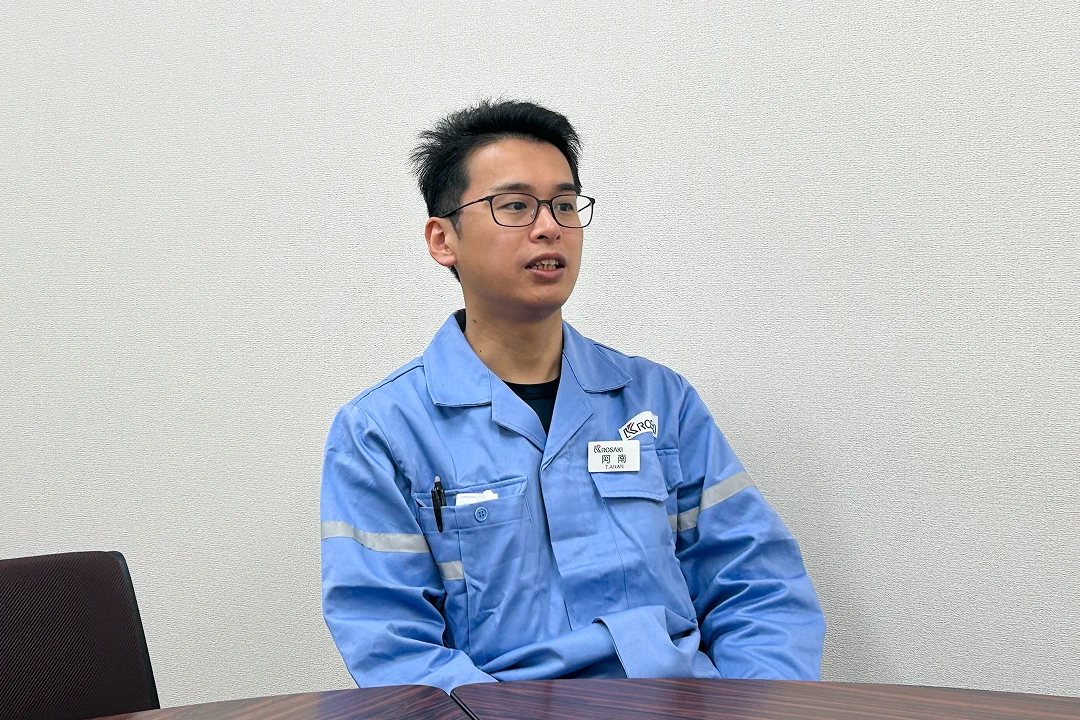
- Takahiro ANAN, Manager, Ako Production Technology Group, Setouchi Plant, Furnace Refractories Division, Krosaki Harima Corporation
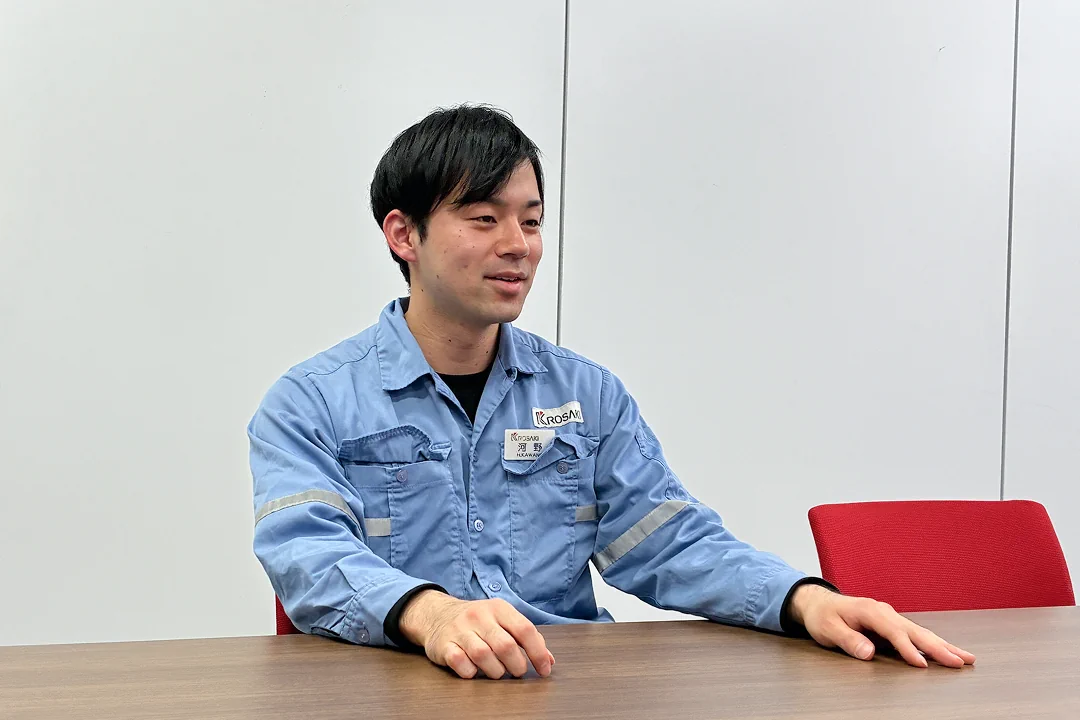
- Hayate KAWANO, Engineer, Product R&D Center, Technical Research Laboratories, Krosaki Harima Corporation
The emotion behind the brand name: “the symbiosis of refractories and the environment”
Please tell us what kind of product MAGreenX™ is.
Kawano:
MAGreenX™ is a refractory product used in steel mills, known as magnesia carbon bricks. It is primarily made of magnesium oxide and graphite.
It is also notable for its application in the “RH degasser” during the “Secondary Refining Process” in steelmaking.
By using MAGreenX™, customers can improve the energy efficiency during secondary refining process.
Moreover, compared to products widely used as of now in secondary refining facilities, it offers various benefits such as being chromium-free and reducing CO2 emissions during production.
What makes it different from previous refractory products?
Fuchimoto:
Until now, or even today, “Magnesia-Chrome” bricks, commonly known as mag-chrome bricks which are primarily composed of magnesium oxide and chromium oxide, have been widely used in RH degasser.
However, MAGreenX™ is a product that can replace these mag-chrome bricks.
Please tell us the origin of the name MAGreenX™.
Anan:
In addition to magnesium oxide, which is a component of the product, we incorporated the word “green” to convey the image of an “environmentally friendly product”.
As a result, I believe we have created a product name that better represents the concept of “symbiosis of refractories and the environment”.
During the naming process, we repeatedly solicited brand name candidates and conducted surveys within the related departments to refine ideas together.
Initially, there was no “X” at the end of the name, but during this process, the idea to add “X” to emphasize “Future Potential” was proposed.
As a result, I believe it became a wonderful name that expresses the product as “more environmentally considerate product”.
Kawano:
Magnesia is closely related to our lives, being used not only in steelmaking and refractories but also in health products.
I believe that having a word in the product name that evokes magnesia makes it easier for customers to feel familiarity and interest.
Fuchimoto:
Currently, I am in a sales position, but I find it very beneficial that the product has a “name that represents its function”, in addition to technical presentations.
Until now, it was common to introduce products by specific material names for each customer, with technical points and prices being the main focus of discussions.
Through this activity, I feel that we have been able to discuss the socially important point of “Environment” with customers while introducing our products.
The field where MAGreenX™ excels – Technical value in RH degasser
What kind of customers would you strongly recommend MAGreenX™ to?
Kawano:
Before explaining the value of MAGreenX™, let me briefly explain the “RH degasser” where MAGreenX™ is used.
The RH degasser is equipment used in the “Secondary Refining Process” in steel mills. It involves adding oxygen and metals into molten steel to adjust its temperature and chemical composition, ultimately achieving the required steel quality.
Therefore, the refractories used as linings in the equipment are subjected to harsh conditions.
Specifically, what kind of harsh conditions are there?
Fuchimoto:
Examples include “temperature, time and chemical composition”. Each varies depending on the type of steel being manufactured, production plans, and may differ for each customer or even for the same customer at different times.
In such a harsh environment for refractory bricks, what kind of value can MAGreenX™ deliver?
Fuchimoto:
In RH degasser, oxygen is blown into the molten steel to lower the carbon content in the steel or to raise its temperature.
At that time, high-temperature Fe-oxide is generated. When magnesia carbon bricks with high carbon content are used in such situations, a phenomenon called “Liquid-phase Oxidation” occurs, causing the carbon in the product to disappear and the surface structure to become porous.
When that happens, it becomes impossible to achieve high performance.
MAGreenX™ aims to improve performance by minimizing the carbon content, while also providing various benefits to customers.
Insulation effect like a thermos bottle. Contributing to improved energy efficiency by reducing “Heat Loss”
What other benefits are there besides performance?
Anan:
In magnesia carbon bricks, there is a correlation between carbon content and thermal conductivity. Products with lower carbon content have lower thermal conductivity, meaning they are less likely to conduct heat.
Earlier, it was explained that there is an operation to raise the temperature of molten steel in RH degasser. However, if products with high thermal conductivity are used in such equipment, heat is conducted through the product and released outside the equipment. Such phenomena are referred to as “Heat Loss”.
The temperature that was raised with effort can drop just by the choice of product, right?
Fuchimoto:
That’s right. Therefore, when using magnesia carbon bricks in RH degasser, it is better to minimize the carbon content from the perspective of reducing heat loss.
I think it would be easier to understand if you imagine a regular mug and a thermos bottle.
Kawano:
Exactly. In that analogy, the mug represents magnesia carbon with high carbon content, and the thermos bottle represents MAGreenX™.
According to our simulation results, using MAGrennX™ can reduce the outer surface temperature of RH degasser by tens of degrees Celsius compared to typical magnesia carbon bricks used in other equipment.
This means that by applying MAGreenX™, customers can maintain a high temperature inside the equipment and produce more efficiently in terms of energy.
Elimination of hexavalent chromium risk and 80% reduction in CO₂ emissions
Please tell us about the products that have been used in RH degasser so far.
Anan:
In RH degasser, mag-chrome bricks are still widely used.
In fact, among Krosaki Harima’s refractory bricks for RH degassers, more mag-chrome bricks are still produced than magnesia carbon bricks.
Mag-chrome bricks remain the main product for RH degasser applications.
What problems or challenges are associated with the widely used ‘mag-chrome bricks’?
Kawano:
Mag-chrome bricks can generate a substance called “hexavalent chromium”, which is harmful to humans and the environment, depending on the conditions. Even if there are no problems before use in steel mills, hexavalent chromium may be generated during use, after use, and until disposal. The biggest challenge with mag-chrome bricks is this hexavalent chromium risk.
However, as I mentioned earlier, it “depends on the conditions”, so mag-chrome bricks are not necessarily harmful in every case.
Anan:
As a manufacturing department, we are always careful about hexavalent chromium in mag-chrome bricks and strive to manufacture products that are less likely to generate it.
Fuchimoto:
The greatest environmental value of MAGreenX™ is that it eliminates the risk of hexavalent chromium generation found in mag-chrome bricks.
Magnesia carbon bricks like MAGreenX™ and TOUGHMAX™ are refractories that do not contain chromium oxide.
Therefore, they can be handled with peace of mind compared to mag-chrome bricks, not only during customer use but also at the time of disposal.
MAGreenX™ is a product that is more friendly to humans and the environment, right?
Fuchimoto:
That is correct.
Are there any other points where MAGreenX™ is superior to mag-chrome bricks in terms of the environment impact?
Anan:
MAGreenX™ is an unburned magnesia carbon brick, so there is no “Firing” process during manufacturing.
Fired bricks require heat generated by burning fuel, and the bricks are fired with that heat. As a result, an excellent structure can be obtained, and products that can withstand high-temperature use conditions are created.
However, when bricks are fired, fuel must be burned, so CO₂ emissions cannot be avoided.
On the other hand, unburned bricks do not have this firing process, and the amount of CO₂ emissions generated during manufacturing is significantly lower compared to fired bricks.
In reality, how different is the CO₂ emission between fired bricks and unburned bricks?
Anan:
When comparing the amount of CO₂ emissions generated when making 1 ton of bricks, unburned bricks can reduce CO₂ emissions by about 80% compared to fired bricks.
Is there that much difference!?
Kawano:
Yes, the energy required for the firing process is that enormous.
If MAGreenX™ expands further in the future, we believe it can contribute even more to environmental protection, not only for customers but also for suppliers.
1.5 times performance improvement and expectations for overseas expansion
How many customers are actually using MAGreenX™?
Fuchimoto:
MAGreenX™ already has many achievements in Japanese RH degassers.
Especially in parts called the lower vessels and snorkels of RH degasser, it is used in place of mag-chrome bricks.
What are the lower vessels and snorkels of RH degasser?
Kawano:
In an RH degasser, two pipes called snorkels are inserted into the molten steel in the steel ladle.
Then, by creating a vacuum inside the RH degasser, the molten steel is sucked up into the lower vessel of the equipment.
Is it like straw?
Kawano:
Exactly like that.
The lower vessel and snorkels of the RH degasser are the parts where the molten steel actually contacts with the refractory bricks when it is sucked up. These can be said to be the areas under the most severe conditions during use.
Therefore, the frequency of replacing refractory bricks is high, and customers have the greatest need for performance improvement in these parts.
The high frequency of replacement means that if MAGreenX™ can be used in this part, its effect will also be significant, right?
Anan:
That is correct.
MAGreenX™ is highly regarded by customers for precisely such applications.
For example, one customer reported that switching from magnesia chrome bricks to MAGreenX™ resulted in 1.5 times better performance.
1.5 times is amazing!
Fuchimoto:
Of course, not all customers will experience the same effect, but as described in the previous example, MAGreenX™ has the potential to significantly reduce environmental impact and improve customer productivity, thereby reducing manufacturing costs.
Are there any precautions when using MAGreenX™?
Fuchimoto:
The thermal spalling, or susceptibility to cracking due to temperature changes, of magnesia-carbon bricks varies significantly with carbon content.
Generally, magnesia-carbon bricks with lower carbon content are more prone to cracking when temperatures fluctuate.
Therefore, it is necessary to adjust the carbon content according to the customer’s usage conditions.
So, it means that products need to be differentiated based on usage conditions, right?
Kawano:
That is right. However, it’s not just MAGreenX™; in general, the quality of refractory bricks needs to be adjusted according to customer usage conditions, and MAGreenX™ is not particularly difficult to handle.
Anan:
Additionally, as many customers have used MAGreenX™, we have received numerous improvement requests and insights, allowing us to make proposals tailored to customer conditions.
Fuchimoto:
In the future, we hope that not only domestic but also overseas customers will use MAGreenX™ and experience its benefits.
From domestic trust to a global standard
Is there a possibility that MAGreenX™ can be used in equipment other than RH degassers?
Kawano:
I believe there is a strong possibility.
For example, in electric arc furnaces, which melt scrap and other materials, magnesia-carbon bricks are currently used. In electric arc furnaces, there is insight suggesting that lowering the carbon content from current levels might be beneficial under certain conditions, leading us to believe that materials based on MAGreenX™ could demonstrate high performance in the future.
Thank you, is there anything else you would like to convey at the end?
Kawano:
The RH degasser is an effective and important facility to improve steel quality, and the demand for refractory bricks is expected to increase further.
In such a context, we hope to appeal not only for improved product durability but also for the value of reducing environmental impact.
As a member of the research department, I intend to work on improving the quality of refractory bricks, including MAGreenX™, and develop products that customers will find valuable.
Anan:
As a person in the manufacturing department, I recognize that my primary responsibility is to deliver products with stable quality. We aim to work together as a factory to improve and consistently manufacture higher-quality products so that MAGreenX™ can be used with greater confidence.
Fuchimoto:
I have experienced development, manufacturing and sales regarding MAGreenX™.
In development, in particular, I took the time to ensure that MAGreenX™ was widely recognized by domestic customers. As a result, I am pleased that many customers have favored MAGreenX™.
I hope that in the future, MAGreenX™ will spread widely around the world and that customers worldwide will appreciate its value.