


2026/09/14
A Second Life for Refractories Returning from Steelworks
Can refractories once destined for disposal become valuable resources again?
Reuniting with Refractories after Their Service
“Thank you for your hard work. Your job is done.”
Whenever we see refractories that have returned from a steelworks, we sometimes feel like saying these words to them.
Refractories are the unsung heroes that protect steelmaking equipment from molten iron and molten steel at temperatures exceeding 1,500°C. After performing their role under such severe conditions, they are removed during equipment maintenance or renewal and are generally referred to as “used refractories.”
But whenever we look at them, we find ourselves asking:
“Is this really the end?”
Value Remaining in Used Refractories
Used refractories still contain valuable materials such as magnesia and alumina. Although they may look worn out, we believe they still hold value that can be put to good use.
Of course, they cannot simply be reused in new products as they are.
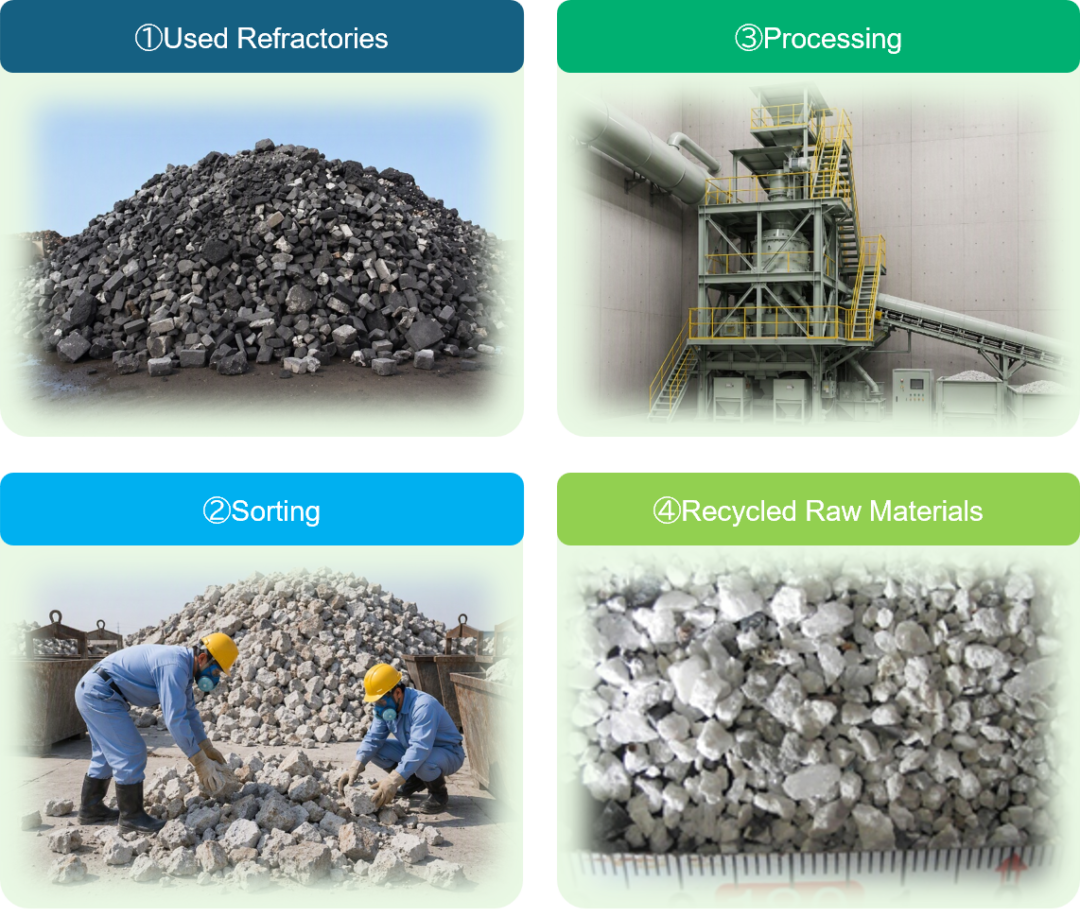
Refractories recovered from steelworks often have iron and slag attached to them. Their condition also varies depending on the equipment and operating conditions in which they were used. Each material must therefore be carefully examined, sorted, processed, and assessed to identify suitable new applications.
This is by no means an easy task.
Nevertheless, we continue to take on this challenge because we strongly believe that it would be a waste to discard materials that can still be used.
Turning Waste into Resources Together with Our Customers
Krosaki Harima cannot pursue this initiative alone.
The cooperation of our customers is essential for collecting and evaluating used refractories. Information about how the refractories were used at a steelworks and the condition in which they were recovered provides important clues for advancing recycling technologies.
Through repeated trials and close collaboration with our customers, we continue working to transform materials once regarded as “waste” back into valuable “resources.”
Connecting Resources to the Future
Advancing refractory recycling does more than reduce waste. It can also limit the use of new natural resources and help reduce environmental impact.
Most importantly, materials that have completed their original role can be reborn to support manufacturing once again.
The story of refractories returning from steelworks does not have to end there.
After completing their original service, the materials are sorted, processed, and given new value before returning to the manufacturing process. This is more than recycling. It is a challenge to carry valuable resources forward into the future.
Giving Refractories a Second Life
We aim to give an increasing number of refractories a “second life.”
Krosaki Harima will continue working with our customers to expand the cycle of resource circulation and pursue manufacturing in which “the end of use does not mean the end of value.”