


2026/09/01
Insulation Technology Born from Our Expertise as a Refractory Manufacturer (The KROTECT™ Story Part 2)
How KROTECT™ Contributes to Energy Conservation and CO₂ Emission Reduction
In the first article in our series on KROTECT™, a nanoporous insulation material, we introduced its key features and explained why preventing heat from escaping is so important.
In this second article, we explore the technological strengths of KROTECT™ and how Krosaki Harima’s extensive expertise as a refractory manufacturer made its development possible.
Refractories and Insulation Materials Work Together
First, let us take a closer look at the structure of an industrial furnace.
Industrial furnaces and heat treatment equipment operating at high temperatures are not constructed from insulation materials alone.
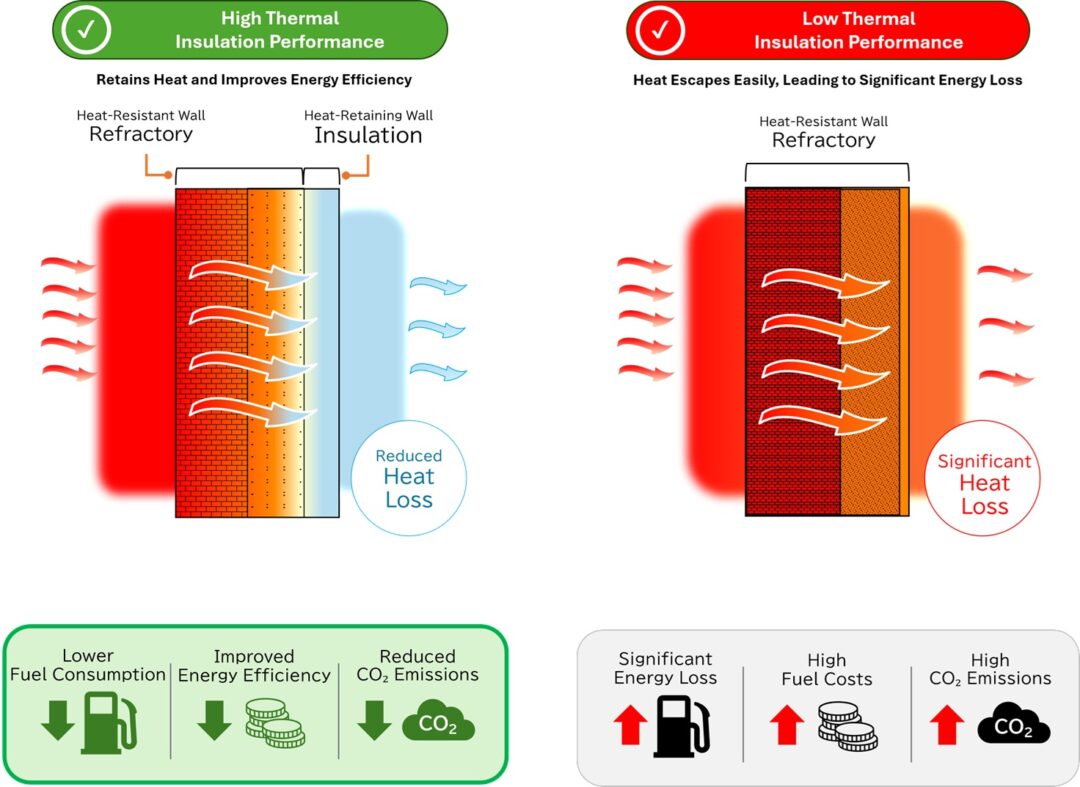
Inside a furnace, refractories protect the equipment in areas directly exposed to extremely high temperatures from molten steel, flames, and other heat sources. Insulation materials are installed outside the refractory lining to reduce heat dissipation from the furnace to the surrounding environment.
In many applications, KROTECT™ is installed behind the refractory lining, near the inner surface of the furnace’s outer steel shell. The refractories protect the equipment from extremely high temperatures, while KROTECT™ reduces heat loss, thereby contributing to the efficient use of thermal energy.
In other words, the two materials have distinct but complementary roles:
- Refractories protect equipment from high-temperature environments.
- KROTECT™ reduces heat loss from the equipment.
Together, they help ensure both the operational safety and energy efficiency of high-temperature equipment.
Refractories and insulation materials are therefore not competing products. Rather, they are partners that complement each other and enhance the overall performance of the furnace lining.
Krosaki Harima has accumulated extensive knowledge and expertise through many years of experience as a refractory manufacturer. This background gives us a deep understanding of furnace lining structures and heat flow, enabling us to develop KROTECT™ as an insulation material that addresses the specific challenges faced by our customers.
KROTECT™: Developed by Krosaki Harima, a Company That Harnesses Heat
For many years, Krosaki Harima has worked closely with high-temperature equipment as a comprehensive ceramics manufacturer.
In 2026, we established a new corporate philosophy that defines our purpose as follows:
Our Purpose
Harness heat, support society,
and create a prosperous future.
https://www.krosaki.co.jp/new-philosophy-en/
Heat is closely connected to our business. Through our many years of experience, we have developed a deep understanding of overall furnace structures and heat flow. This knowledge enables us to develop insulation materials by considering where insulation is needed, what level of thermal insulation performance is required, and what lining configuration is optimal.
KROTECT™ was created through the distinctive knowledge and capabilities that Krosaki Harima has cultivated as a comprehensive ceramics manufacturer.
A Technology Developed over Approximately Five Years
The development of KROTECT™ took approximately five years.
The development team began by searching for the most promising materials from which to create a higher-performance insulation material. After evaluating numerous candidates, the team focused on fumed silica, the main constituent of KROTECT™.
Fumed silica contains countless microscopic pores that are invisible to the naked eye.
By focusing on this microscopic structure, the development team thoroughly investigated two fundamental questions:
- How can heat transfer be reduced even further?
- How can the inherent properties of the material be maximized?
Through this research, the team identified a material capable of reducing thermal conductivity by approximately 20% compared with conventional products.
This achievement represented an important breakthrough, but the development process was far from complete.
Overcoming the Challenge of Strength
Improving thermal insulation performance can make an insulation material more susceptible to damage. This is a well-known challenge in the development of insulation materials.
For customers to use a product with confidence, an insulation material must satisfy several requirements:
- Low thermal conductivity
- Sufficient strength
- Ease of handling
To achieve all three, the development team optimized the material formulation with the support of materials informatics, an AI-based approach to materials development.
As a result, KROTECT™ was successfully developed with both low thermal conductivity and high strength. Its improved strength also makes the material easier to handle during installation and assembly.
Another Challenge: Establishing Mass Production
Achieving excellent results in a laboratory is not enough to create a commercial product.
The material must deliver the same performance at actual product scale, and it must be manufactured consistently and reliably.
To accomplish this, Krosaki Harima constructed a dedicated production line for KROTECT™. The development and manufacturing teams worked closely together, repeatedly testing and refining both the equipment and the production process until a consistent production system was established.
KROTECT™ was brought to life after approximately five years of continuous development. The product embodies Krosaki Harima’s materials technologies, manufacturing expertise, and accumulated knowledge of high-temperature applications.
Reducing CO₂ Emissions through Better Insulation
Preventing heat from escaping means preventing energy from being wasted.
Although insulation materials are rarely visible from the outside, their contribution to environmental performance should not be underestimated.
By reducing wasted thermal energy, KROTECT™ contributes to both energy conservation and lower CO₂ emissions. When applied to industrial furnaces, it is also expected to provide greater CO₂ emission reductions than conventional insulation materials.
KROTECT™ is an insulation solution developed through Krosaki Harima’s technological expertise to keep valuable heat inside equipment. By maximizing the effective use of thermal energy, KROTECT™ will continue to contribute to energy conservation and the transition toward a decarbonized society.
Conclusion
KROTECT™ is more than a high-performance insulation material.
It is the result of Krosaki Harima’s long-standing expertise in refractory technology, materials development, and thermal engineering.
Through its ability to keep heat where it belongs, KROTECT™ will continue to maximize the value of thermal energy and contribute to energy conservation and the realization of a decarbonized society.